
Marsa Gabal El Rosas
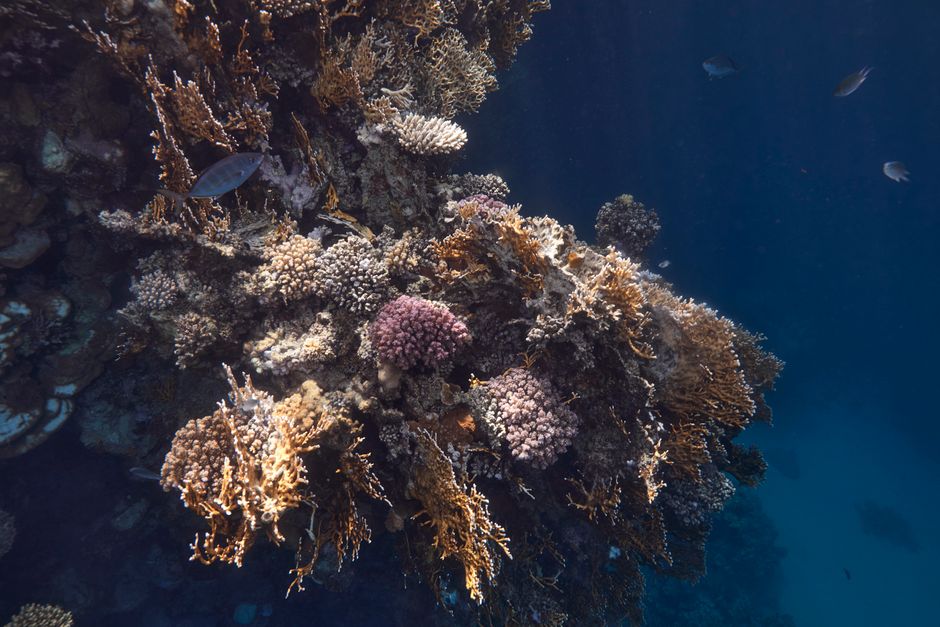
A sheltered reef bay north of Marsa Alam, with northern and southern reef arms, a sandy lagoon, small cavities along the northern reef and deeper outer reef sections.
Quick Facts
Quick Facts
Location
North of Marsa Alam · approximately 11–15 km, depending on the reference point
Access
Shore Dive
Depth
5–25 m sheltered · up to ~40 m deeper reef
Experience
Open Water to Advanced, depending on profile
Current
Generally mild in bay · variable on outer reef
Visibility
Typically 20–30 m
Famous For
Coral reef, sandy lagoon, caves & deeper reef
Why Dive This Site?
Why Dive This Site?
Two Reef Arms
Two parallel reef arms create a distinctive sandy lagoon between them.
Shore Diving
The site is accessible directly from shore with a sandy entry.
Two Small Caves
Small cavities are documented along the northern reef and can be observed from outside. Their exact number, depth and internal configuration should not be assumed.
Sandy Lagoon & Seagrass
The central lagoon contains sandy bottom with patches of seagrass and algae.
Rich Coral
Hard coral covers the reef structures and provides habitat for reef fish and marine life.
Deep Reef Profile
Deeper sections of the wider reef system may extend towards approximately 40 m, offering additional possibilities for appropriately trained and experienced divers. Actual dive depths depend on the selected area and operator.
The Dive Site
Marsa Gabal El Rosas
Depth
5–25 m sheltered area · up to ~40 m deeper reef
Dive Level
Open Water to Advanced, depending on profile
Conditions & Currents
Generally mild in the sheltered bay. Variable on the outer reef. Visibility typically 20–30 m.
Dive Description
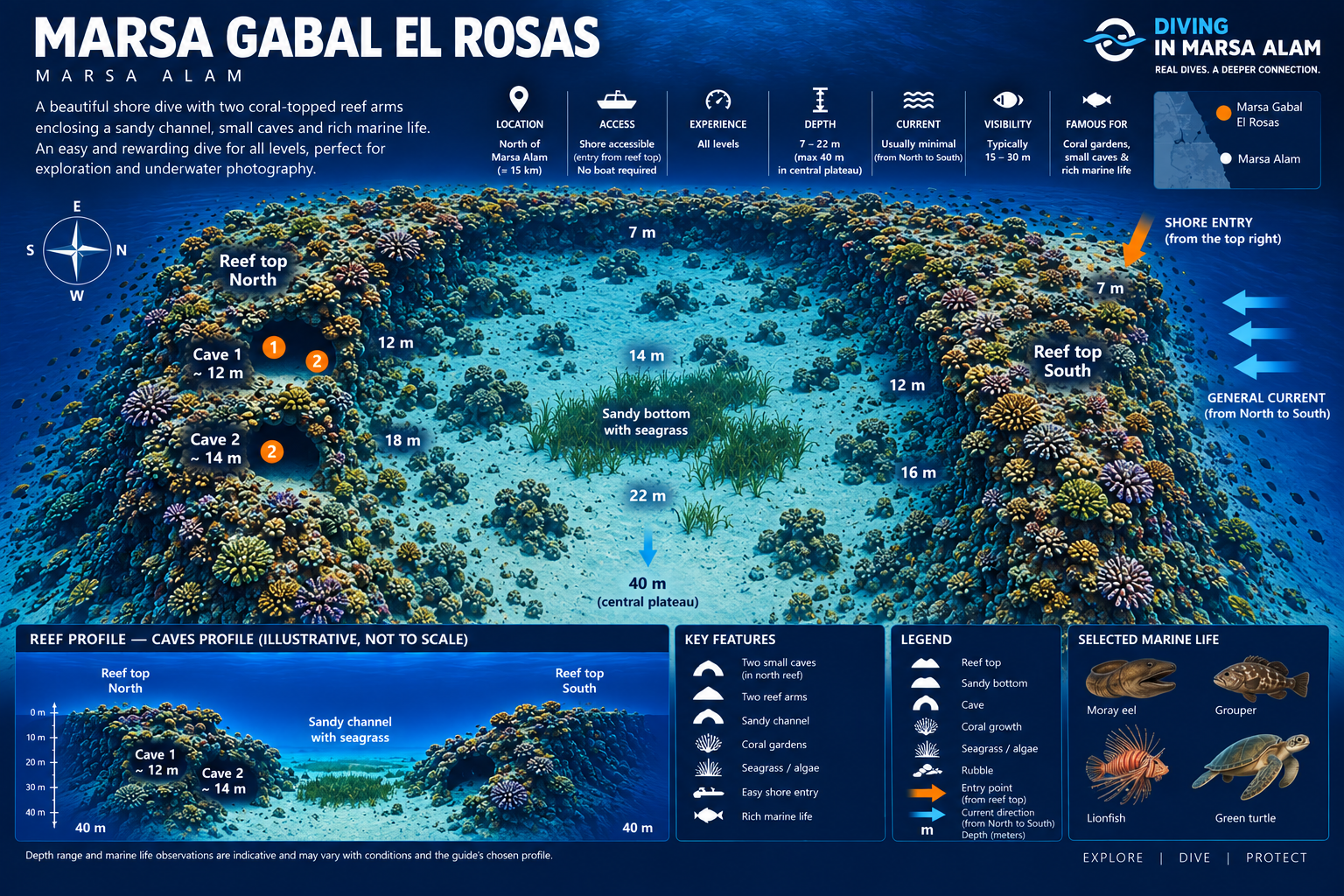
Marsa Gabal El Rosas is a shore-diving site at the foot of Gebel El Rosas mountain, north of Marsa Alam. Two parallel reef arms enclose a sandy lagoon with patches of seagrass and algae. The northern reef features two small enclosed caves close together — they are cavities rather than swim-throughs and do not lead through the reef. Shore entry is from the upper-right side of the southern reef. The sheltered bay provides shallow to intermediate diving (approximately 5–25 m), while the deeper reef and central plateau can reach approximately 40 m as shown on the approved Dive Map. The general current direction shown on the map runs from north to south, with the sheltered bay generally experiencing mild current and the outer reef potentially experiencing stronger conditions. There is no single fixed route — the actual profile is selected according to certification, conditions and the guide’s plan.
Choosing your route and planning the visit
The protected-looking shape of Gabal El Rosas should not replace an entry assessment: waves and low water can reduce visibility near shore. The reef inside the bay and the outer Nemo City area should also be distinguished. The latter is described separately by local operators and can involve a boat approach, greater depth and stronger current. Ask which sector is intended before choosing the dive. For a relaxed bay visit, concentrate on reef structure, small fish and a comfortable return rather than trying to include every named feature.
Location & How to Get There
Marsa Gabal El Rosas is a shore-diving bay north of Marsa Alam, approximately 11–15 km from town depending on the reference point. The sheltered bay has a sandy beach entry, while access to some outer reef sections may be arranged by boat. The exact entry point and route depend on local access, conditions and operator arrangements.
Marsa Gabal El Rosas
Open in Google MapsDive Map
This map is an illustrative reference for the Marsa Gabal El Rosas site layout, not a surveyed navigation chart or a fixed dive route. Depths, current direction, cave locations and entry points shown on the illustration must be confirmed locally before diving. The actual route depends on conditions, diver qualifications and the operator’s assessment.
Site-Specific Features
Site-Specific Features
The Two Northern Caves
Small cavities are documented along the northern reef. They can be observed from outside during an appropriate reef dive. Their exact number, depth and internal configuration are not established by the available sources. Do not enter enclosed cavities or overhead environments as part of this profile.
Sandy Lagoon & Seagrass
The central sandy channel/lagoon forms the sheltered interior of the site, with patches of seagrass/algae and scattered coral formations. The lagoon provides a sheltered environment between the two reef arms.
Gebel El Rosas Reef
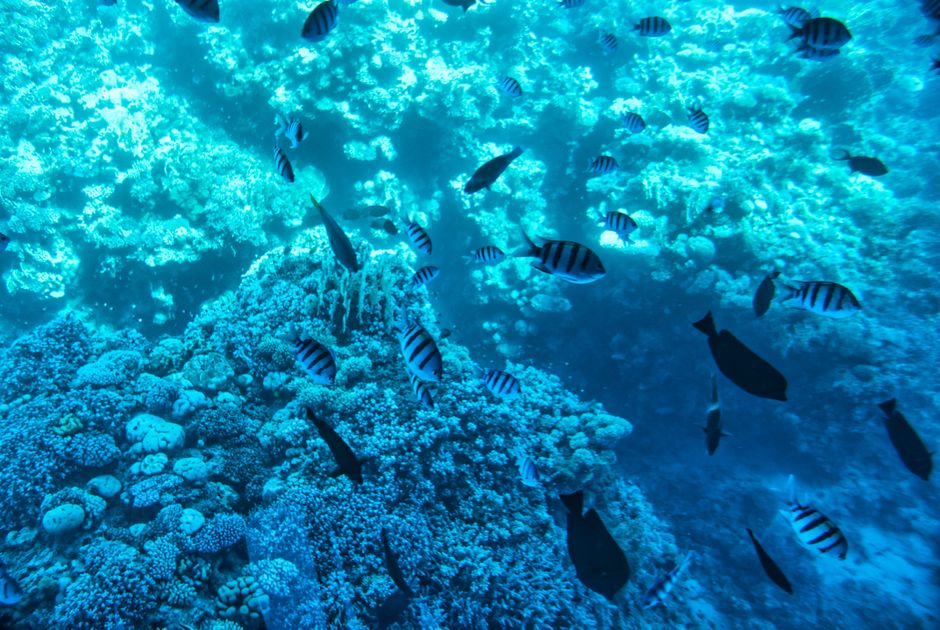
Coral-covered reef arms enclose the lagoon. Hard coral covers the reef structures and provides habitat for reef fish, glassfish, lionfish, moray eels and other marine life. The reef arms create the distinctive geography of the site.
The Deeper Reef
Deeper sections of the wider reef system may extend towards approximately 40 m, although the maximum depth of a particular dive depends on the selected area and operator. These routes require suitable qualifications, experience, gas planning and depth management. Exposed outer reef sections may also have stronger or changing currents.
Dive Profiles
Dive Profiles
Sheltered Lagoon / Shore Profile
Depth Range
Approximately 5–25 m
Reef Zone
Sandy lagoon, reef arms and shallow sheltered bay
What to Expect
A shore dive exploring the sheltered sandy bay and suitable sections of the reef arms. The inner bay is generally protected and offers shallow routes for appropriately qualified divers. Deeper extensions depend on the selected route, diver qualifications and conditions.
Current Considerations
Current is generally mild inside the sheltered bay, but strength and direction can vary. The guide assesses conditions and selects the route.
Marine Life Focus
Reef fish, lionfish, moray eels, glassfish, trumpetfish, two-banded snapper.
Experience Implications
Suitable for Open Water divers on routes within their training and depth limits, normally up to 18 m for PADI Open Water. Extensions towards 25 m require appropriate deeper-diving qualifications and experience. The guide selects a suitable profile for the group.
Northern Reef / Cave Area
Depth Range
Shallow to intermediate depths along the northern reef; the exact depth of the cavities is not independently verified.
Reef Zone
Northern reef and exterior of its small cavities and coral formations.
What to Expect
Explore an appropriate section of the northern reef and observe its small cavities from outside. The available sources do not establish their exact number, depth or internal configuration. This profile does not include entering caves, enclosed cavities or other overhead environments.
Current Considerations
Generally mild in the sheltered bay. Conditions can vary and the guide determines the plan.
Marine Life Focus
Glassfish, lionfish, giant moray, reef fish around the caves and northern reef.
Experience Implications
Suitable for Open Water divers and above on an appropriate exterior route within their training and depth limits. Maintain good buoyancy near the reef and do not enter enclosed cavities.
Deeper Reef Profile
Depth Range
Up to approximately 40 m
Reef Zone
Deeper sections of the wider reef system, selected according to conditions and diver qualifications.
What to Expect
A possible deeper dive along suitable sections of the wider reef system. Some areas may extend towards approximately 40 m, but this is not a fixed route or a guaranteed dive depth. Outer reef conditions may be more demanding than inside the sheltered bay. The route and maximum depth depend on the selected area, conditions, diver qualifications and the operator’s assessment.
Current Considerations
The outer reef may experience stronger or changing conditions. The guide assesses whether this profile is viable on the day.
Marine Life Focus
Reef fish, rays and anemonefish where suitable reef habitat is present.
Experience Implications
Requires certification and training appropriate to the planned depth, sufficient experience, gas planning and suitable conditions. A dive approaching 40 m is not an Open Water profile and requires appropriate deep-diving qualifications and procedures. The actual maximum depth must remain within the diver’s training, certification and planned limits.
Conditions & Currents
The sheltered inner bay at Marsa Gabal El Rosas generally experiences mild current, while exposed outer reef sections may have stronger or changing conditions. No prevailing current direction has been independently established for the site. Visibility is often good but can decrease near the sandy entrance during strong waves or low tide. The guide assesses the conditions and selects an appropriate route on the day.
Who Is This Site For?
Marsa Gabal El Rosas offers different profiles for different experience levels. Open Water and recreational divers can enjoy the sheltered shallow and intermediate shore profile where conditions permit. Intermediate divers can explore the broader reef and cave area. Experienced and advanced divers can explore the deeper reef profile approaching 40 m, which requires appropriate certification, experience and gas planning. Underwater photographers will find subjects ranging from coral gardens and reef textures to caves, marine life and the sandy lagoon. Not every profile is suitable for every certification level — the guide determines the plan based on conditions and the group.
Marine Life
Marsa Gabal El Rosas
Lionfish
Lionfish may be encountered around reef edges and coral formations, especially during dawn, dusk and night dives.
Moray Eels
Moray eels may be found in crevices and holes along the reef edge, often seen during day and night dives.
Turtles
Turtles may be encountered around the shallow reef and surrounding areas.
Pipefish
Pipefish may be found among seagrass and reef edges, rewarding patient macro observation.
Lionfish
Possible
Moray Eels
Possible
Turtles
Possible
reef-fish
Characteristic
macro-life
Possible
Pipefish
Possible
Wildlife encounters can never be guaranteed. These are wild animals in their natural habitat.
Wildlife Etiquette
DO: Maintain neutral buoyancy. Observe animals without chasing. Protect coral. Follow the guide.
DO NOT: Touch coral. Stand on reef. Touch wildlife. Chase turtles, sharks or rays. Enter the caves.
These guidelines are essential for responsible diving at Marsa Gabal El Rosas — respecting the reef and its wildlife is the only way to keep it healthy.
When to Dive
Marsa Gabal El Rosas can be dived year-round, with conditions determining the best profile on the day. No specific seasonal wildlife pattern is established for this site. Local conditions can vary and should be assessed by the guide. Water temperatures range from approximately 22°C in winter to 30°C in summer.
Shore Diving
Marsa Gabal El Rosas is primarily a shore-diving site with a sandy entry into the sheltered bay. Some operators may also arrange boat access to outer reef sections. The exact entry point and dive route depend on local access, conditions and operator arrangements.
Underwater Photography
Marsa Gabal El Rosas offers good opportunities for both wide-angle and macro photography.
For wide-angle work, the coral gardens, reef walls, cave entrances and the sandy lagoon are the primary subjects. The two reef arms and the lagoon provide interesting compositions. Glassfish schools and reef scenes reward wide-angle compositions.
For macro, the reef edges, seagrass patches and coral structures support pipefish, small reef fish, lionfish and macro subjects. Patient, slow observation produces better results than active pursuit.
Responsible photography is essential. Maintain neutral buoyancy at all times. Do not touch, chase or block any marine life. Avoid contact with coral. Do not enter the enclosed caves. Allow wildlife to determine the distance. The goal is to photograph behaviour as it unfolds naturally.
Safety & Practical Information
Listen carefully to the guide’s briefing before entering the water. Conditions can vary — the sheltered bay generally has mild current but the outer reef may experience stronger conditions. Stay within the planned profile and maintain excellent buoyancy. Avoid contact with the reef and coral. Do not enter enclosed cavities or overhead environments as part of the profiles described here. The deeper reef profile reaching approximately 40 m is not for beginners and requires appropriate certification, experience, gas planning and local briefing. Careful depth management is essential on the deeper profile. Follow the guide’s instructions at all times. Surface signalling equipment (SMB) should be carried where appropriate to the dive plan.
Planning your visit
Shore dive with sandy entry
Sheltered bay: 5–25 m · Deeper reef: up to ~40 m
Two small enclosed caves on the northern reef
General current: north to south; strength varies
Location: approximately 15 km north of Marsa Alam
Access: shore dive with sandy entry
Coordinates: 25.2055° N, 34.8350° E
Visibility: typically 20–30 m
Gallery
Marsa Gabal El Rosas
FAQ
Marsa Gabal El Rosas
Marsa Gabal El Rosas is located north of Marsa Alam, approximately 15 km from Marsa Alam town, at the foot of Gebel El Rosas mountain.
Sources and editorial review
Content reviewed on 20 October 2026. Conflicting descriptions are identified in the text. Sea conditions and access arrangements require local confirmation.
Prices
Clear, honest diving prices
No hidden costs. Daily diving, packages, courses, and private options — all in one place.
View Diving PricesReady to dive Marsa Gabal El Rosas?
A sheltered reef bay north of Marsa Alam, with northern and southern reef arms, a sandy lagoon, small cavities along the northern reef and deeper outer reef sections.
Enquire About This Dive